
Every wedding has a moment the planning guides rarely mention. It arrives a few weeks before the day, when the phone starts buzzing and does not really stop. A cousin wants the dress code. An aunt asks about parking. Someone needs the hotel block link again. A friend texts to ask what time to arrive, then texts an hour later to ask the same thing a slightly different way. None of it is hard on its own. Together, it quietly turns the couple into a full-time information desk during the very weeks they hoped to enjoy.
Guest communication is one of the least talked about sources of wedding stress. It does not show up on the budget or the timeline, but it shapes how the final month actually feels. When it goes well, guests arrive relaxed and on time, and the couple gets to be present. When it goes badly, the group chat becomes a second job, and small questions pile into a low hum of pressure that follows you right up to the aisle.
This is worth planning for as carefully as the flowers or the food, because it touches every single person you have invited.
The Job No Couple Signs Up For
When people imagine wedding planning, they picture the big decisions. The venue, the dress, the menu, the music. What they rarely picture is the sheer volume of small logistical questions that come with hosting a large group of people in one place at one time.
Think about what a guest actually needs to know. Where the ceremony is and where the reception is, if they differ. What time to arrive. Where to park or whether there is a shuttle. What to wear. Whether children are welcome. Where they are staying and how to book it. What the plan is if it rains. Whether there is an after-party, and how to get there. Now multiply every one of those questions by a guest list that can easily run past a hundred people, and you begin to see the scale of it.
The couple ends up answering the same handful of questions dozens of times, often late at night, often while trying to manage everything else. It is nobody’s fault. Guests are not being difficult. They simply want to show up correctly for a day that matters to them, and the couple is the obvious person to ask.
Why a Wedding Website Is Not Always Enough
The standard advice is to build a wedding website and put everything on it. That advice is sound, and a good site does help. A clear FAQ page, a schedule, directions, and dress code details can answer a lot before anyone has to ask.
But here is the truth most couples discover too late. A website is passive. It waits to be visited. Plenty of guests never open it, or open it once weeks before and forget what it said. The people most likely to text you a question are often the same people least likely to go hunting through a website to find the answer. So the site quietly does its job for the organized half of your guest list, and the other half still reaches for their phones and messages you directly.
The result is a strange split. You did the work of building the website, and you are still answering the questions.
A Simpler Path: Let Guests Just Ask
There is a newer approach that fits how people actually behave, and it starts from a simple observation. Guests already live in their text messages. They do not want to download an app, make an account, or learn a new system for one wedding. They want to ask a question the way they ask everything else, by typing it into a text and getting an answer back.
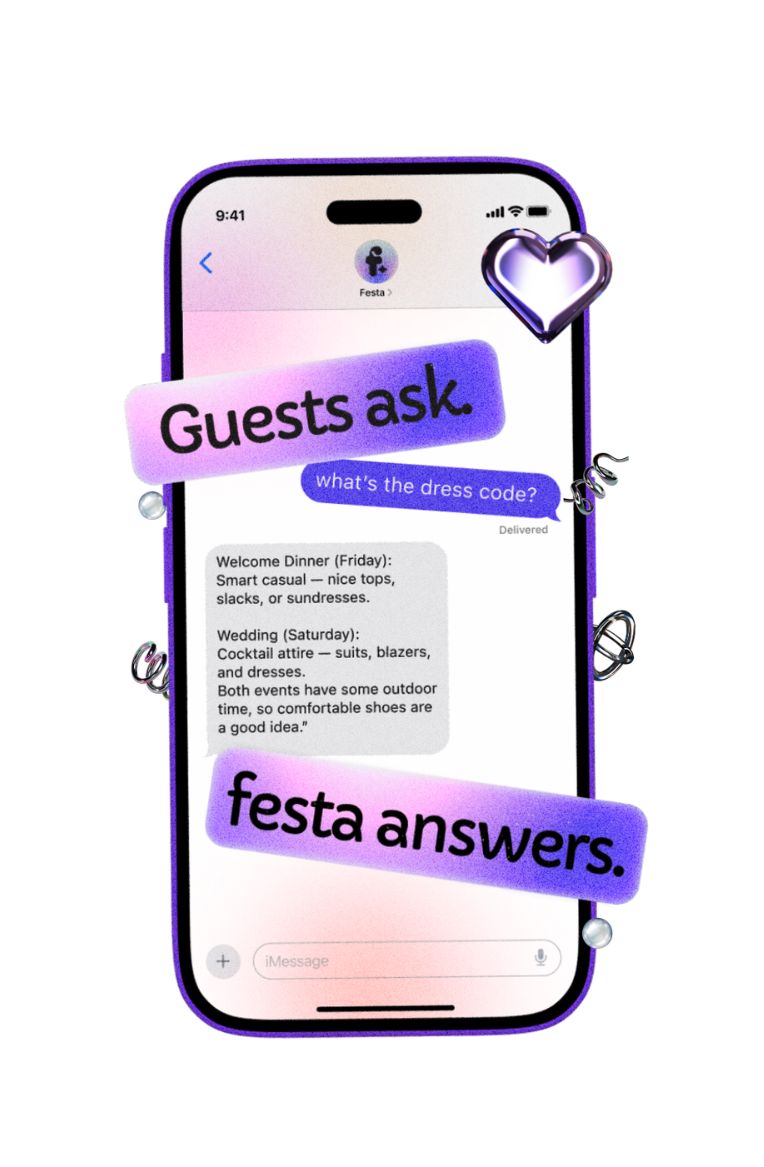
This is the idea behind Festa, an AI wedding coordinator that answers your guests over text so you do not have to. Instead of fielding the questions yourself, you hand them to something built for exactly that. Guests message one regular number and get instant answers about the schedule, the dress code, parking, directions, and everything else they would otherwise have asked you. There is nothing for them to install and nothing to sign up for. The moment they receive the invite, they have a direct line to every answer they need.
For the couple, the effect is immediate. The group chat stops being a source of dread. You still control all the information, you simply stop being the one who has to repeat it forty times.
What This Looked Like at a Real Wedding
It is one thing to describe an idea and another to see it work on an actual wedding weekend, so here is a real example.
Jenn and Cole got married last October in Colorado Springs with 39 guests. In the weeks before the wedding, those 39 people were on track to ask the same questions over and over, spread across texts and calls at every hour. Instead, they texted Festa. Over the wedding weekend it handled 285 messages from guests.
The numbers tell a quiet story. More than half of the guest list opted in and messaged on their own, without being chased. And 83 percent of the questions came in before the wedding day itself, which meant that by the time Jenn and Cole walked down the aisle, most of their guests already knew where to be and what to wear. The questions people asked were exactly the ones couples brace for: location and directions, the schedule, the dress code, and parking.
The moment that captures it best happened at four in the morning on the day of the wedding. A guest texted, asking how to get a ride to the ceremony. Festa answered. Jenn and Cole slept through it and never knew until later. No call to the bride. No frantic scramble. Just a guest getting what they needed, and a couple resting before the biggest day of their lives.
That is the whole point of getting guest communication right. It is not about technology for its own sake. It is about protecting the couple’s attention so they can actually be present.
RSVPs and the Text Versus Email Question
Guest communication is not only about answering questions. It also covers the parts of planning couples tend to dread most, like collecting RSVPs, meal choices, and sometimes payments.
Many couples go back and forth on whether to handle RSVPs by email, by paper card, or through their website. If you have ever debated text versus email for reaching your guests, the honest answer is that people reply to texts far more reliably than they reply to email. Texts get opened. Emails get buried. When RSVPs live in the same text thread where guests are already asking their questions, responses come in faster and with less chasing, because you are meeting people exactly where they already are rather than asking them to go somewhere new.
Folding RSVPs into the same channel also takes pressure off your wedding website. The FAQ section, the directions, the running order of the day, all of it becomes something a guest can simply ask for and receive in seconds, rather than something you have to design perfectly and hope they read.
What Is Still Coming
It is worth being clear about what exists today and what is on the way. Right now, Festa answers guest questions and handles guest communication over standard text messaging for weddings in the United States and Canada.
The team is also building toward something more proactive, and this part is on the roadmap rather than live today. The vision is a coordinator that does more than answer questions when asked. It would watch the event as it unfolds and step in before problems reach the couple, so that if a shuttle time changes or a group of guests all start asking about the same thing at once, the right update goes out automatically. That layer is still in development, but it points to where this kind of tool is heading.
Keeping the Focus on Being Present
At the heart of all of this is a simple goal that has nothing to do with software. Couples want to enjoy their own wedding. They want to be guests at the party they spent a year planning, not the help desk running it.
Good guest communication is what makes that possible. Whether you lean on a detailed website, a well-organized group of helpers, a tool that answers guests for you, or some combination of all three, the aim is the same. Give your guests a clear, easy way to get answers, and give yourself permission to stop being the only source of them.
Conclusion
The questions will come no matter what. That part is out of your control. What you can control is how they reach you, and whether they land as a constant stream of interruptions or get handled quietly in the background.
Wedding guest communication rarely makes it onto the planning checklist, yet it shapes the final weeks more than almost anything else. Couples who plan for it, whether through a thoughtful website, a clear system, or a tool like Festa that answers guests over text, tend to arrive at their wedding calmer and more present. And in the end, being present is the whole reason for the day. Everything else is just logistics, and logistics are exactly the kind of thing worth handing off.